
When Does a Village Stop Being a Village?
It is not new homes, EV chargers or renewable infrastructure that threaten rural life. It is what happens when local people lose control over the places they call home.

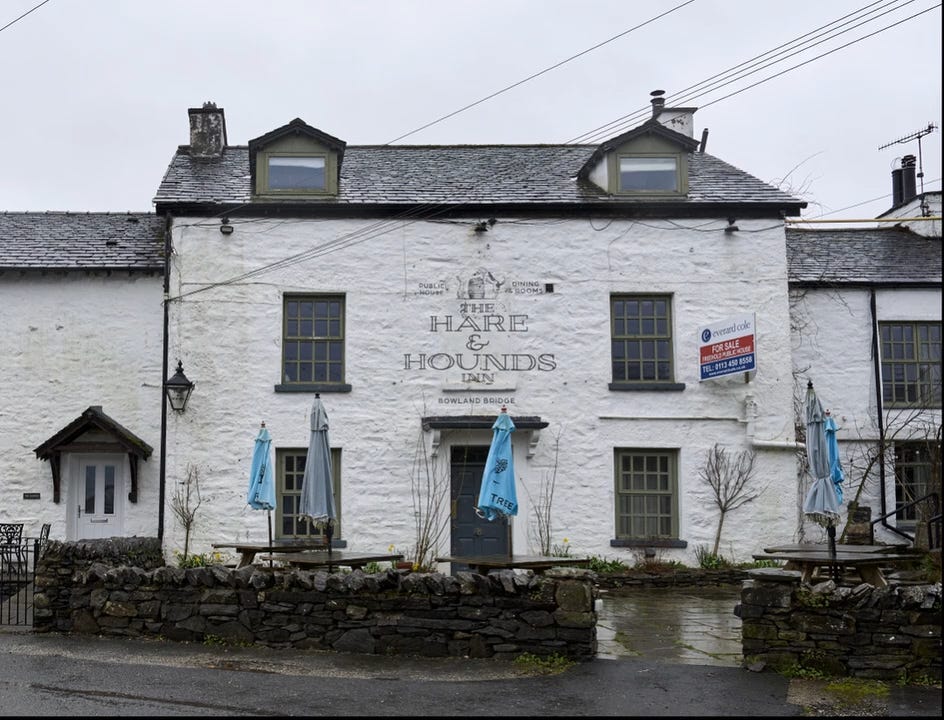
Image: Hare & Hounds Inn, Bowland Bridge, Lake District
Up For Sale But Who’s Buying?
The Hare & Hounds Inn has sat at the heart of the Bowland Bridge community for over 400 years, welcoming locals and visitors grateful for the warming fire, hot food and a place to rest for a few hours or overnight
No longer, as it’s up for sale. Another data point to add to the grim set of statistics that report the hundreds of rural businesses that are dying every year. Plunkett UK estimates that in 2024 alone, around 300 village shops and 200 pubs closed, alongside wider losses of schools, healthcare, public services and public transport.
Almost all of them are small businesses that serve the public. Beyond pubs and B&B’s it’s village shops, garages and filling stations, the post office, church, doctors surgery, dentist, and even the primary school.
These sorts of closures aren’t isolated to the countryside, but the difference is much more noticeable because closure means longer journeys to the closest alternative.
Individually, they are but a small pin prick on Google Maps. Easy to ignore if you don’t have a reason to look for them, and when you do, while looking for somewhere to visit, discover that they’ve closed.
The commentary in the lead up to and after their closure is largely localised. Occasionally, there may be a bigger feature in the national media. Such was the case with the Hare and Hounds whose closure was featured in the Guardian last week as part of a series called “The story of Britain in six empty buildings”.
If an obituary is written, it will focus on the contribution that the business made to its community and how hard it will be to replace. It may well include some testimonials from villagers and visitors who reminisce about the impact it had on their life.
A period of mourning will begin. Felt most profoundly by those who were closest to the business - the owners, employees and regular customers. Often, there will be anger that fuels the formation of local action groups who try to find ways of re-opening the business they care so much about.
When they look at what their village is becoming, they know that inaction is not an option.
Turning a blind eye feels like an implicit admission that the village is on an unavoidable trajectory towards one of two futures: slow decline, as services disappear one by one, or imposed industrialisation, as housing, energy and digital infrastructure arrive without enough local control. Neither future feels much like progress.
It seems that either way, policy makers are not bothered enough. Or perhaps they are looking in the wrong places, measuring the wrong things, and failing to notice the moment when villages stop being villages.
When does a village stop being a village?
A village does not stop being a village because it gains new houses, EV chargers, renewable infrastructure or better digital connectivity. Change itself is not the problem.
A village stops being a village when the people who live there lose meaningful control over the assets, services and decisions that shape daily life. That is the question at the heart of this article: not whether rural communities should change, but who gets to shape that change and who benefits from it.
Village: Definition - A small community or group of houses in a rural area, larger than a hamlet and usually smaller than a town.
This to me, is a rather dated definition and isn’t representative of life today in rural Britain. Villages are growing arms and legs. They might still be called villages in spirit, but the developments taking place on their periphery give them a different look. To some this may be a mark of progress, for others it’s a highly unwelcome personality transformation.
Local councils are charged with controlling infrastructure developments around the villages that they have responsibility for. In truth, their powers are increasingly diluted by central Government’s push to hit housing and renewable infrastructure development targets.
In the absence of stronger local controls, the probability of villages morphing into small towns connected to industrial infrastructure rises significantly.
That’s when we know for sure that the village has stopped being a village.
Government’s ignorance and ambivalence is firmly linked to the centralisation and urbanisation of policy making in the UK. If your professional and personal life centres around Greater London or Edinburgh, it’s impossible to fully appreciate what the day to day pressures of rural life.
There are without doubt many diligent backbench MPs who are fighting hard to support the rural communities that they represent. The trouble is that the “blob” that is the Civil Service and the Treasury isn’t actively listening.
What exactly is the Government’s vision for villages?
From my vantage point it’s muddled and becomes obvious when national policy ambitions collide with local reality:
Government wants farmers to grow more food, while also encouraging land to be set aside for nature recovery.
It wants more homes built on the edges of longstanding villages, even where that removes productive farmland.
It wants to decarbonise homes, transport and industry, while knowing that much of the enabling infrastructure will sit close to rural communities.
It says it supports rural tourism, while higher energy costs, business rates and employer costs make survival harder for hospitality and accommodation businesses.
It knows rural communities are ageing, yet access to local healthcare, dentistry and care workers continues to weaken.
Why its vision continues to be so muddled is beyond me when so many countless enquires and consultations have been undertaken. There is no excuse for ignorance!
Sadly, here we are in May 2026, and too many policy makers have only the slimmest understanding of life outside of the city. Occasional visits to the countryside on day trips or family holidays cannot be used as a proxy.
Perhaps we shouldn’t expect Government to set a vision for rural Britain. The landscape and the people are too diverse to congeal into a single vision statement. Policy makers will always be too disconnected.
So, the existing playbooks need to be ripped up, or at the very least rewritten. Villages can only remain villages when the people who directly contribute to them are empowered to not just set the vision but to implement it through community ownership.
Charge my Street - A Case Study in Community Ownership.
This is where community ownership becomes more than a defensive response to decline. It can also shape how villages absorb the infrastructure they genuinely need, including EV charging, renewable energy, shared mobility and digital connectivity.
You may have come across Charge my Street, who are a social enterprise that installs and operates community EV chargepoints in Cumbrian villages. They raise money through community shares with all profits are reinvested with a view to growing the EV chargepoint network.
I present them as a case study in how a vision for stronger villages becomes a reality without ceding control to outside developers. Chargepoints are necessary assets in villages because they meet growing demand from residents and visitors. However, if they are located in the wrong places and used as profit maximisation tools then their social value is lost.
Charge my Street is run by people who know their operating area like the back of their hand because it’s been their home - not just a place they pass through - for many years. They are trusted by locals in a way that outsiders rarely are. The trust strengthens when villagers are confident that their investments and the money they spend on charging sessions stays in the community.
Getting a social enterprise up and running and keeping it going is hard. I know because I run one. It’s even harder when it’s an infrastructure centric business. It requires people who are willing to work for free or little money for a while and have a breadth and depth of capabilities that aren’t easily found in and around villages.
It’s for these reasons that the vision of community ownership can fall flat. It’s not for lack of energy and passion, it’s limited resources and expertise.
Community ownership should not be treated as a sentimental rescue act for pubs, shops and halls. By the end of 2024, Plunkett UK recorded 828 trading community-owned businesses across the UK, including 459 shops and 205 pubs, breweries and distilleries.
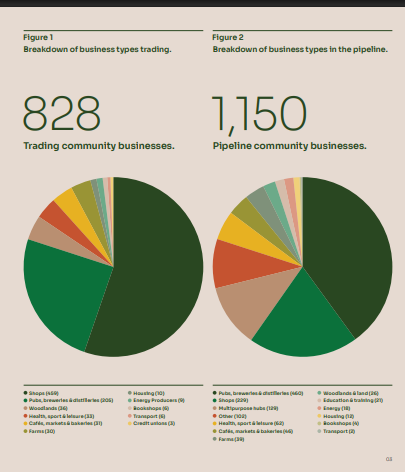
Source: Plunkett UK - Community Ownership: A Better Form of Business
The sector has grown by almost 59% over the past decade, with an average of 31 new community businesses opening each year.
How to Turn Villages into Hives of Community Ownership
Did I mention earlier that plans are afoot for the Hare and Hounds in Bowland Bridge to be purchased by the local community? I don’t think so which is why it’s worth returning to where this article began.
Locals in the village don’t want the for sale sign on the front of the pub to become a blight so they are applying for Asset of Community Value status which pauses the sale process so community groups have time to prepare a bid.
Doing so will be no easy task as they will have to demonstrate that they can raise the funds necessary to purchase the pub and operate it on a financially sustainable basis.
Community ownership is a path that a growing number of local action groups are following because they know that it’s the only viable long-term solution to the ills that have befallen their village.
The economic arguement for community ownership is evidenced by Plunkett’s Power to Change research indicating that for every £1 spent with a community business, 56p stays in the local economy, compared with 40p for large private sector firms.
If Government is serious about resilient rural communities, it should treat community ownership as a core delivery model, not a last resort. That means patient funding, practical training, technical support, and transport links that allow knowledge, people and services to move more easily between villages.
Funding is of little use if local people do not have the skills or confidence to spend it well. Training is of limited value if villages are difficult to reach. And transport links are not just about convenience; they are part of the enabling infrastructure that allows community ownership to move from aspiration to delivery.
Concluding Remarks
Change is not the enemy. The real danger comes when change is imposed without local consent, local benefit or local ownership. If villages are to remain living communities rather than commuter settlements, visitor backdrops or convenient sites for infrastructure, the people who sustain them need more than sympathy after the next closure.
Plunkett found that the most common barriers to community ownership were negotiating a purchase with the asset owner, cited by 30%, and raising sufficient funds, cited by 27%. It also notes that previous research suggested around one in three supported community groups may reach trading, compared with one in ten without support
They need the power, skills, funding and transport connections to shape what comes next. The future of rural Britain should not be decided by whoever has the deepest pockets, the fastest planning consultants or the neatest policy target. It should be shaped by the people who still know what makes a village worth fighting for.