
I'm still here
Just been working on other stuff these last few weeks. Here's what's been happening


You likely won’t have noticed given how much of a battle it is to keep on top of our inboxes, but since mid-May, I stepped away from Substack to complete the write up of a year long research project into the future of UK water transport (aka ferries) which was funded by the Foundation for Integrated Transport.
In a round about sort of way, this research supports my work on rural e-mobility. It does so because you only need to look at a map of the UK to see how important ferries are to many rural and island communities. The “e” in e-mobility stands for electric, and while there are very few ferries that are powered by batteries - or any other form of low/zero carbon fuel - that will change over the next few years.
I’ll share the full report with you over the coming weeks once it’s been fully edited. For now, what I can reveal is that it dives in some depth into the pathways that ferry operators can follow to decarbonise their fleets, the challenges with each, and the learnings that the UK can take from other countries (e.g. Norway) who are further ahead in the process.
8 key findings emerge from the report that are summarised in the graphic below. Out of the 8, the one that I recommend you pay most attention to is number 1. Water transport is critical (national) infrastructure but public recognition is uneven.
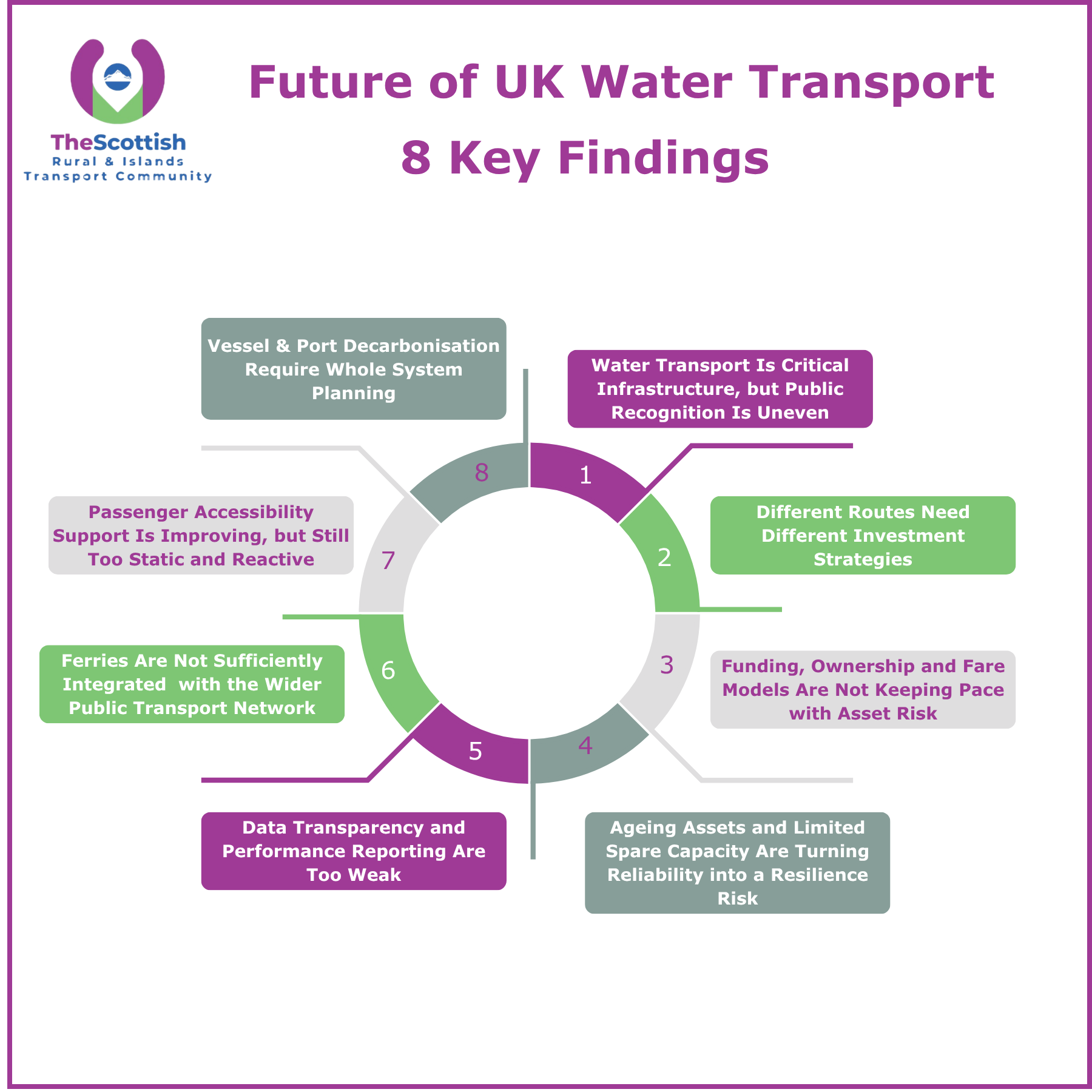
Recognition is uneven because, unlike buses and trains, ferries are not in close physical proximity to most people’s everyday life. They are outliers in a literal sense. Yet without them, our economy would grind to a halt. That’s no exaggeration. What would happen if all of the ferries that cross the English Channel and Irish Sea stopped sailing - all at once - for a week?
Importantly, the impact isn’t just economic, it’s social. Especially, for island communities where ferries are a lifeline transport service. No ferries,. no way of getting to the mainland for a hospital appointment, funeral or overseas family holiday.
Anger among islanders has grown in recent years as elderly ferries become increasingly prone to abrupt breakdowns, leaving locals and visitors up the creek without a paddle (poor methphor).
Disconnected and very often disinterested MSPs and MPs who spend too much of their time in Edinburgh and London add fuel to islanders’ anger.
More to follow on this important subject. If you’ve a deep or even passing interest in water transport, then I welcome your thoughts.
Rural and Islands EV Charging Virtual Cafe
A couple of weeks ago, I briefly resurfaced from my ferries report writing to preview here a EV charging online/virtual Cafe that the Scottish Rural and Islands Transport Community (SRITC) were running on 8th June. As a Director at SRITC, it fell on my shoulders to organise and promote the Cafe. If you did sign up and join the event, I trust you found it informative. If not, you can watch an edited recording below.
We were delighted with the number of people who joined the Cafe - over 40- and the positive feedback we’ve received. What the Cafe confirmed is the need for the charging sector to engage at a much deeper level with public facing rural and island businesses, many of whom are at the very early stages of learning about the ins and outs of charging.
While there seems to be an obsession with rolling out ever faster public chargers, lost in the conversation is the enduring value of slow (AC) charging in places where visitors are spending time. This is hardly breaking news, but hotels, BnBs, self catering lodges don’t need fast/rapid (DC) chargers. Loads of these businesses aren’t yet offering any form of charging.
Then there’s paying for charging. Someone at the Cafe - I can’t remember who - asked if any chargers accept cash….
Well no, of course not. Why on earth would anyone need to use cash? Maybe perhaps because it’s when you’re in the middle of nowhere, and discover that the only charger within 15 miles that can get you charged for the next leg of your journey has a faulty payment terminal, and you can’t open the operators app becuase, drum roll, the mobile coverage is rubbish.
While inserting notes and coins into a charger that could easily be broken into is a bad idea, surely there is a fall back/fail safe solution? Interestingly, Eamonn Hennessy from Charge My Street (Community Interest Company) who install chargers in rural parts of Cumbria mentioned during the Cafe that if needed, their support team will remotely turn on a charging session (free of charge) for a driver who finds themselves stuck.
The Cafe was a success but what’s going to happen next? Most immediately, SRITC will take the lead in organising a Focus Action Group which participants at the Cafe were largely supportive of. In practice, the group will bring together stakeholdeers who represent different types of businesses that have a say in the success of rural and island EV charging. Most notably
Rural businesses who are already, or could, offer EV charging to their customers
Manufacturers of slow (AC) chargepoints
Installers and maintainers of slow chargepoints
Tourism and hospitality sector membership organisations.
As the name confirms, the ethos of the group is about identifying and following through on actions that create impact within rural and island communities. This will almost certainly include some form of educational roadshow that enables all of the above stakeholder groups to meet in-person in different rural locations around Scotland - and maybe beyond - over the next 12-18 months.
The big and straightforward idea is to remove geography as a barrier to education and collaboration. Yes, there’s loads of online content that you might argue removes the need for in-person gatherings, but no, I don’t accept that arguement. There’s no substitute for getting together in the places where EV charging is much more than another utility.
If you’d like to be part of the action group then please get in touch.
What I Learned from My Annual Pilgrimage to the Royal Highland Show
The third week in June means only one thing as far as I’m concerned. It’s not Scotland playing in the World Cup or the US Open Golf championshop on Sky Sports but the Royal Highland Show at the Ingleston Showground just outside Edinburgh.
I’ve written here before that as child- come hail or boiling sunshine - we’d be packed in the car, onto the ferry from Arran and drive up the M8 from Glasgow to Edinburgh to join the queue of cars snaking there way into the showground. The day trip was all about my folks meeting up with all of their farmer relatives and friends. Indoors in hospitality tents or cowsheds or outdoors at a tractor dealers stand.
Returning to the show in recent years reveals that while the world as changed in so many ways over the decades since my childhood, the show at its heart is still about human connection. The simple ritual of meeting people you haven’t seen in 12 months and sharing the personal and professional highs and lows of the year.
Lest we not forget that farming is often a lonely profession with opportunities for socialising few and far between. Is it any surpise that the busiest venues at the show last week were the bars!
While clocking up the miles walking round the showground (it’s big) is how little space was devoted to electric vehicles (of all sizes). There were a few electric passengers vehicles on display but stuck away in a far corner of the ground. It confirms that the electification/decarbonisation of agricultural and forestry equipment is still at a fairly early stage. It’s hardly worth agri-dealers and manufacturers showing protoptypes at the show because they know that full scale commercialisation is years away.
Even though they’re powered by diesel, there are many cool bits of equipment to gape at. Here’s my favourite from the forestry demonstration centre.
The sound isn’t great but what’s this bit of equipment does is pick up large logs with the grab which has a chainsaw built into it which then chops the big log into smaller slices. It’s a unique bit of equipment designed by my friends at Jas P Wilson Forestry in Dumfries.
Aside from the iffy weather this year, my only gripe is with the food prices. £7.50 for a bacon roll!! Really?
What to Expect in July and August
With the reporting writing out of the way, July and August are an opportunity for me to get back into the rythem of pushing out weekly articles here. There are loads of rural e-mobility subjects that merit discussion. Some new and some well worn. All still important and topical.