
Conversations First, Infrastructure Second
Let's talk now, not later, about when and where rural EV charging infrastructure is installed

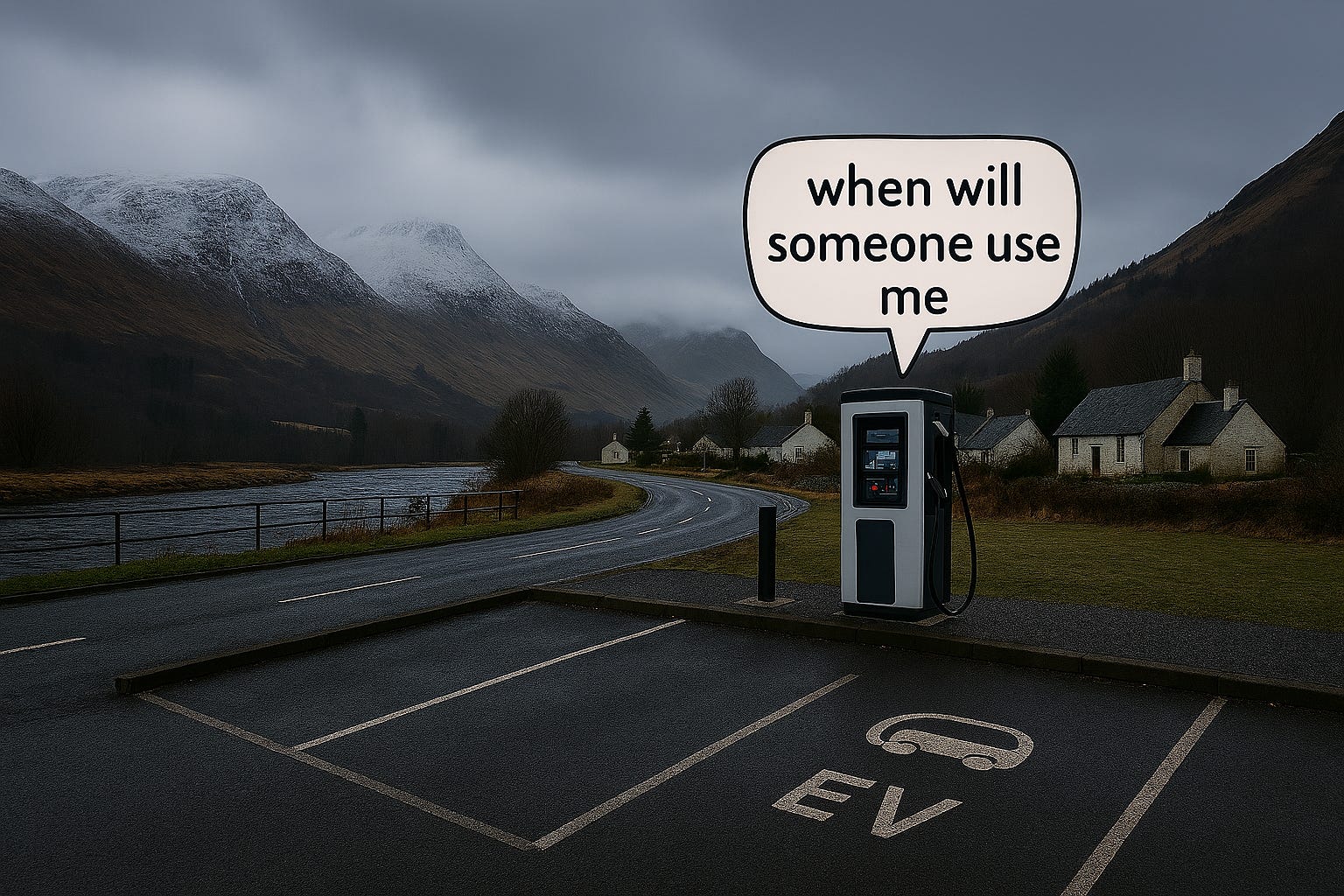
In my last newsletter I discussed why economic deprivation, not a scarcity of public charging infrastructure, is the barrier to EV adoption in rural areas. A policy of “build it and they will come” is of little value if no-one is there to regularly using public chargepoints that have been installed at great expense on kerbsides and in car parks. We need to put honest conversations ahead of technology deployment.
Placing blind faith that the households that are supposed to be the primary beneficiaries of public chargers are aimed at - those without off-street parking - will be driving EVs in the next few years is ill advised. Many of these households are at the sharp end of the cost of living crisis. If they have a car, it’s likely an older one that they struggle to keep filled up with petrol. EVs are way out of reach to them - even 2nd hand ones - so unless there are dramatic improvements in their circumstances, why should we assume that they will be better placed to buy one before the end of this decade?
Exactly when households in different locations and income brackets purchase an EV matters a lot when estimating chargepoint utilisation levels. Adoption forecasts are sensitive to the performance of the economy and changes in Government policy. An increase in food and energy costs that force low income households to choose between heating and eating is a clear signal that they will further delay the purchase of an EV.
Of no help whatsoever to these households is the current cost of public charging. Where the costs of charging versus fuelling are marginal the urge to go electric is weak. Recent news that the Government is - at long last - considering equalising the VAT rate on home and public charging is step in the right direction. Nonetheless, in the mind of a buyer with few pennies to spare at the end of each month, it’s debatable whether they feel a greater sense of urgency.
Then there is the planned 3 pence per mile road tax on EVs that the Government plans to introduce in 2028. Put to one side how on earth they will implement it in its current guise, and wihout doubt it’s a red flag for drivers in rural communities who - as I’ve mentioned many times before - driver further and spend more, to reach work, healthcare services, and supermarkets.
What about the financial incentives that Government are offering to accelerate the take-up of EVs? Will they persuade more of these households to make the switch? I think not because the subsidies that are currently available exclude 2nd hand EVs, the type of vehicle that lower income drivers would naturally lean towards.
The cost of new EVs is dropping rapidly - driven by the import of sub £25,000 Chinese models - so perhaps that will by the catalyst for low income households? Maybe. However, remember if you will - another point I’ve mentioned before - how most drivers go about buying their first EV.
Research confirms that they rely on dealers to help them make the leap from a “considerer” to a buyer. This isn’t surprising given the nerves that come with driving an EV for the first time. It needs to be sat in, examined and driven for confidence to grow.
All good apart from the fact that if you live out in the sticks, you may well be far from the closest EV dealer. Unless the stars have aligned financially for you, the motivation to make the trek to a dealer is pretty low. You’ve got bigger, more pressing priorities.
Are we having honest conversations that address these realities? If we are, I’m missing them. The headline numbers on the sale of EVs and installation of new public chargepoints don’t reveal with any great accuracy who socio-demographically are doing the driving and charging.
If Governments north and south of the border are committed to raising more people out of poverty then a good idea would be to support those who are most car dependent and drive the furthest with specific financial incentives. Means testing would need to be used to determine eligibility but, come on, surely that’s doable.
An honest conversation about the pro’s and cons of this idea must take account of what the people it’s aimed at are contributing to the place that to their community. Many work in lower income jobs in the public and social care sectors. They are key worker. Some may be lucky enough to be driving a fleet vehicle but not all, by any stretch.
In the private sector, rural areas are dominated by small businesses, the vast majority employing less than 10 people. Their daily struggles are well reported. Whether it’s a pub, village shop or hotel, they all face a highly uncertain future as the cost of employing workers, heating their premisis, and purchasing supplies increases. How many of these business owners are in a rush to buy an EV?
Thinking a little deeper about who is most likely to use rural public chargers now and in the near future, it seems logical to conclude that it’s going to be visitors. This is reflected in local authority roll out plans where a small percentage of chargers will be DC rapid or ultra-rapid (above 50kWh). They are needed and should be prioritised for installation so as to meet growing demand from day trippers. That said, utilisation levels will be lumpy. Lots of use from April to October, and a good bit less over the winter months.
Generalising about visitor utilisation rates is fraught with danger especially in rural areas because the weather can dictate whether day trips go ahead. With the great British weather being so variable, in the middle of summer there can be gales and downpours, and in December an unexpected change in the gulf stream bringing a short burst of warmer weather and more people out for walks in the countryside and visits to national parks.
It’s for these reasons, I strongly feel that running towards a somewhat arbitrary target set by the Government on the total number of public chargers needed by 2030 sends the wrong signal to the market. It’s been the same story for a while in the renewables space. Set a target on how much capacity is needed (GwH) and push the market to build, build, and build even more wind turbines and battery storage farms.
Chargers sitting idle for most of the day is in no one’s interest. It’s not good for the chargepoint operator, not a good look for the council, and likely to be frowned upon by locals who argue that the space should be freed up for use by non-EV drivers.
The time for honest conversations must start now with locals at the forefront of them. Their lived experiences (that phrase does make me cringe) must shape planning decisions. Top down data driven decision making only takes you so far when you’re looking at rural spaces. Their diversity requires bottom up input from the people who are most familiar with journeys that take them to and from their village during all sorts of weather.
We’re moving from a world of centrally planned and controlled infrastructure to a decentralised one where local people decide what’s best for their community. There are example of this happening now right across the country and many more will follow in the future. Ownership of this infrastructure and profits from the economic and social benefits it creates is the key to building resilience into rural communities.